
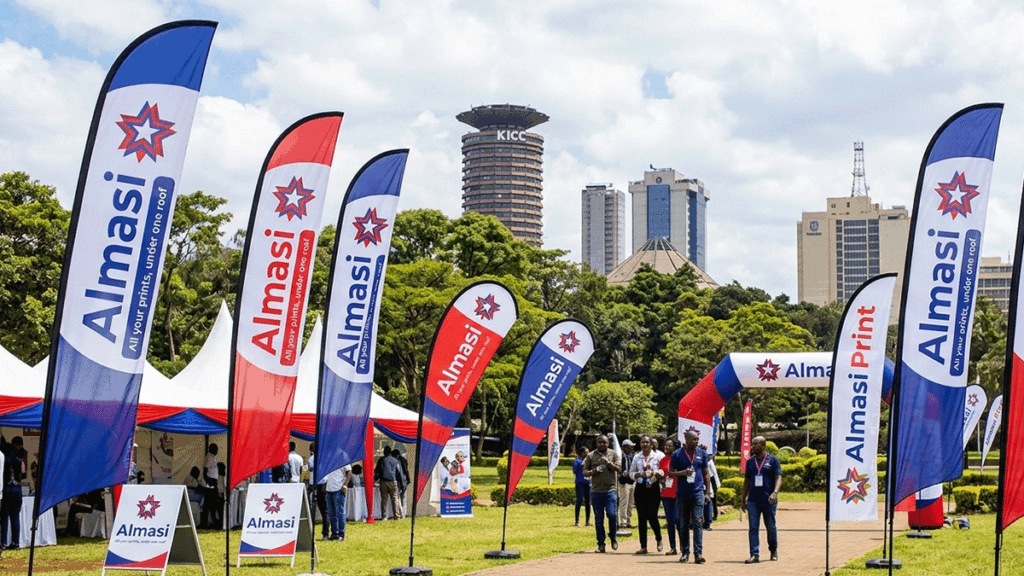
When you need branding that grabs attention outdoors, at a launch, an expo, a forecourt, or a roadside activation, a flag does the job a roll-up banner can’t. But teardrop flags, feather flags, and telescopic banners each behave differently in wind, space, and setting. Pick the wrong one, and it either topples over or gets lost in the crowd. This guide makes the choice simple.
At Almasi Prints, we print all three in-house with fade-resistant dye-sublimation, so your colours stay bold through Nairobi sun and rain. Here’s how to choose.
Why flags beat banners for outdoor branding
Roll-up banners are built for indoors — a gust of wind will knock one flat. Flags are engineered for the opposite: their tall, narrow shape and flexible poles let them move with the wind instead of fighting it, so they stay standing and keep waving your brand above head height, where people actually see it.
They’re also portable, reusable, and quick to set up on almost any surface with the right base. For any outdoor event in Nairobi, a flag is the workhorse.
Teardrop flags: the stable all-rounder
Shape: a curved “teardrop” that’s wide at the top and tapers down. Best for: windy or open locations, forecourts, and anywhere you want a stable flag that reads well from a distance.
The teardrop’s pole runs through a tight sleeve along the curved edge, keeping the fabric taut. That tension does two things: it keeps your logo readable even in a breeze (less flapping), and it makes the flag more stable in wind than a feather flag. If you’re branding a fuel station, a car yard, or an exposed outdoor venue, a teardrop is usually the safe pick.
Watch-outs: slightly smaller print area than a tall feather flag.
Pros: excellent wind stability, taut, readable graphics, compact footprint.
Feather flags: maximum height and visibility
Shape: a tall, vertical “feather” or blade that rises high with a gentle curve at the top. Best for: grabbing attention over crowds, marking entrances, and creating a row of branding along a route.
Feather flags are the tallest option, so they win when you need to be seen above a busy crowd or line several up along a path. The larger vertical area also gives your design more room to breathe. They perform well in light to moderate wind; in very exposed, gusty spots a teardrop holds steadier.
Watch-outs: more movement in strong wind than a teardrop.
Pros: maximum height and visibility, generous print area, great in rows.
Telescopic banners: the adjustable backdrop, not a flag
Shape: a rectangular, height- and width-adjustable banner on a telescopic frame. Best for: stage backdrops, media walls, and step-and-repeat photo walls — usually indoors or in sheltered outdoor setups.
A telescopic banner isn’t a waving flag — it’s a flat backdrop. If your goal is a branded wall behind a speaker or a photo backdrop rather than roadside attention, this is the one you want. Its adjustable frame means one unit can flex to fit different spaces. Explore our telescopic banner and larger media banner backdrops.
Watch-outs: not for windy open-air branding — it’s a backdrop, not a flag.
Pros: adjustable size, ideal for backdrops and press walls, reusable.
Quick comparison: which flag for your event?
| Your situation | Best choice |
|---|---|
| Windy / exposed outdoor spot | Teardrop flag |
| Need maximum height over a crowd | Feather flag |
| A row of flags along a route | Feather flags |
| Forecourt/fuel station/car yard | Teardrop flag |
| Stage backdrop or photo wall | Telescopic / media banner |
| Readable logo with minimal flapping | Teardrop flag |
Still deciding? Tell us your venue and how windy it gets, and we’ll recommend the right option. Get in touch for advice and a quote.
Don’t forget the base
A flag is only as steady as what holds it up. Match the base to your surface:
- Ground spike — for grass and soft ground; drives straight in.
- Cross / X base — for hard floors and paving; add a water or sand weight for wind.
- Water/sand bag weight — essential for hard surfaces in any breeze.
- Wall or vehicle mounts — for fixed or mobile branding.
We’ll supply the right base with your flag — browse the full Displays collection.
Why order your flags from Almasi Prints
- Fade-resistant dye-sublimation — bold colour that survives Nairobi sun and rain.
- All shapes in-house — teardrop, feather, and telescopic, so we recommend what truly fits your event.
- Proof-approved before printing — you approve the design first.
- 24–48hr express turnaround for fixed event dates.
- Trusted by 100+ brands across Nairobi and Kenya.
Order teardrop & feather flags in Nairobi
Send us your artwork and venue details for a fast quote — or browse our Displays shop to get started:
📱 Call / WhatsApp: 0708 000 077 • 0117 325 117 • 0720 457 298
✉️ Email: sales@almasiprints.co.ke
📍 Visit us: Sunrise Building, 2nd Floor, Keekorok Road, Nairobi
Frequently asked questions
What is the difference between a teardrop and a feather flag?
A teardrop flag has a curved, tapered shape that keeps the fabric taut and stable, making it best for windy or exposed spots. A feather flag is taller and more vertical, giving maximum height and visibility over crowds, but it tends to move more in strong winds.
Which flag is best for windy conditions in Nairobi?
Teardrop flags are the most wind-stable because their tight sleeve keeps the fabric taut with less flapping. For very exposed locations, pair any flag with a cross base plus a water or sand weight.
Are teardrop and feather flags suitable for outdoor use?
Yes. Both are designed for outdoor branding and printed with fade-resistant dye-sublimation to withstand sun and rain. Choose the base to match your surface — ground spike for grass, cross base for hard floors.
What is a telescopic banner used for?
A telescopic banner is an adjustable rectangular backdrop, not a waving flag. It is used for stage backdrops, media walls, and step-and-repeat photo backdrops, usually indoors or in sheltered setups.
How fast can you print custom flags in Nairobi?
With print-ready artwork, Almasi Prints offers a 24 to 48-hour express turnaround for urgent event dates. Standard scheduling is the most economical option otherwise.